Open-Source Home Inspection Software: What It Means & Why It Matters
On this page
Open-Source Home Inspection Software
Almost every inspection platform is proprietary: closed code, hosted on the vendor's servers, governed by terms the vendor can change. Inspector Hub is the exception — its engine, OpenInspection, is published under the AGPL v3 license. Here's what "open source" actually means for a working inspector, in plain terms.
What "open source" means (and doesn't)
It means: the full source code is public. Anyone — you, your developer, a security researcher — can read exactly how the software works and how it handles data. You're free to run it, modify it, and host it yourself.
It doesn't mean: you have to be technical, or self-host, or do anything different day to day. Most inspectors use the hosted service at $49.99/seat/month and never touch the code. Open source is the guarantee underneath the product, not a chore you take on.
The four things it gets you
1. No vendor lock-in
With proprietary software, leaving means exporting your data and starting over somewhere else. With open source, your exit is structural: if you ever want out, you can run the exact same software yourself — your inspections, templates, and workflow continue unbroken.
2. Auditable data handling
You don't have to trust a privacy policy — you can verify it. Because the code is public, there are no hidden data sales, no silent background exports, no surprises. What the software does is readable by anyone.
3. Protection from price hikes and acquisitions
This is the one inspectors feel most. The inspection-software market is consolidating — when one vendor acquires another, pricing power concentrates. With open source, the worst case has a floor: if hosted pricing ever turns unreasonable, you self-host the identical code for $0 in license fees.
4. Free self-hosting (if you want it)
Deploy Inspector Hub to your own Cloudflare account in minutes. No license fee, ever. It's there as a safety net and an option — not a requirement.
"Is it as good as the proprietary tools?"
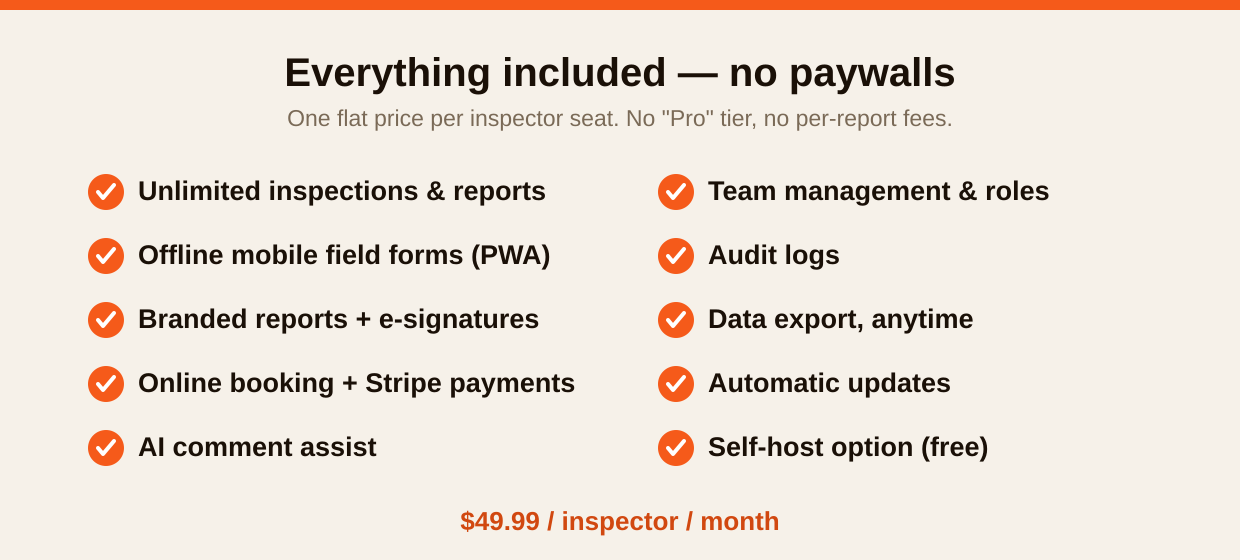
For day-to-day inspecting, yes: offline mobile field capture, branded reports with e-signatures, online booking with payments, AI comment assist, and team management — all included. The open-source license doesn't make the software more basic; it makes the ownership different. You get the modern workflow and the guarantees.
What AGPL v3 means for your business
In practice, for an inspector running their own business: no restrictions that matter. You can deploy it, use it commercially, and keep your inspection data private. The license's share-alike requirement only applies if you distribute a modified version of the software to other people — which the vast majority of inspectors never do.
Try it — or read it first
You can do something here you can't with any proprietary tool: read the source before you ever sign up.
Browse the code on GitHub → · Start free — 5 inspections on us → · See pricing →
Last updated June 2026.
Keep reading
Home Inspection Report Software: What Makes a Great Report (2026)
Home inspection report software that produces branded, mobile-friendly reports with photos, e-signatures, and AI comment assist — at $49.99/seat, all included. What to look for in report software in 2026.
ReadHome Inspection Software Pricing: A 2026 Guide to What You'll Really Pay
A clear 2026 guide to home inspection software pricing: base prices, per-inspector charges, per-report fees, and premium tiers — and how to calculate your real monthly cost before you buy.
ReadHow to Choose Home Inspection Software (2026 Buyer's Guide)
A practical, vendor-neutral guide to choosing home inspection software in 2026: pricing models, data ownership, offline field apps, report quality, and the 7 questions to ask before you buy.
ReadRun inspections on software you control
Inspector Hub gives you modern field reports and a client portal — hosted for you, or run it yourself free on the open-source OpenInspection engine. Your data, always yours.